 Team Hello Vizag
A new invention is designed to let any owner of human data share tested patterns, not records, for AI training. It is described in patent filings made in September and October 2026. The filing says public human data is running low and AI-made data can lower quality. Receipts can carry quantum-resilient signatures. A separate 0→1 Doctrine filing can check decisions pre-execution. Both are Arché Inventions.
LIVE www.0to1doctrine.com
FIRST, THE BASICS: TWO INVENTIONS
A band is a range of values between 0 and 1, such as 0.40 to 0.45, standing in for a precise figure. Band-Based Archive Triage (BBAT) is a filed system for stored data. One part, Band-Derived Training Signals (BDTS), pools bands from many sources and passes on only patterns. These are human-made signals: patterns from data people generated, not text written by an AI. The separate 0→1 Doctrine filing compares needs and abilities on the same scale to check decisions.
THREE WALLS, NOT ONE
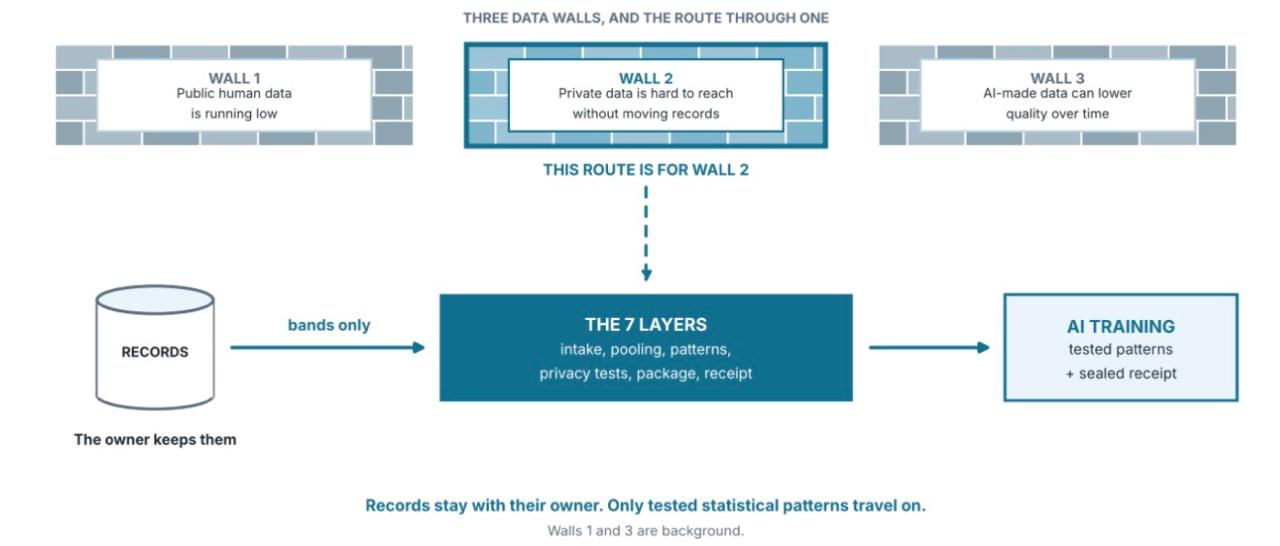
The filing’s background names three pressures. Public human-generated data is approaching exhaustion. Synthetic data used in its place can lower quality with each successive model generation. And the largest remaining reserve of genuine human data sits in private and institutional holdings, which, it says, existing routes can reach only if records leave the holder’s control.
WHY SIGNALS, NOT RECORDS
The filing says existing routes to private data ask the holder to give up control of records. BDTS reverses the order: bands go in and tested statistics come out. It is designed so that a holder sends no record and a trainer receives none. What changes hands is a pattern about a group, designed not to reveal any one person.
Three data walls; the route addresses the private-data wall: records stay with the owner, only bands go through seven layers to AI training as tested statistics with a sealed receipt
Figure 1. Three data walls, and the route that reaches private data without moving records.
SEVEN LAYERS, SOURCE TO MODEL
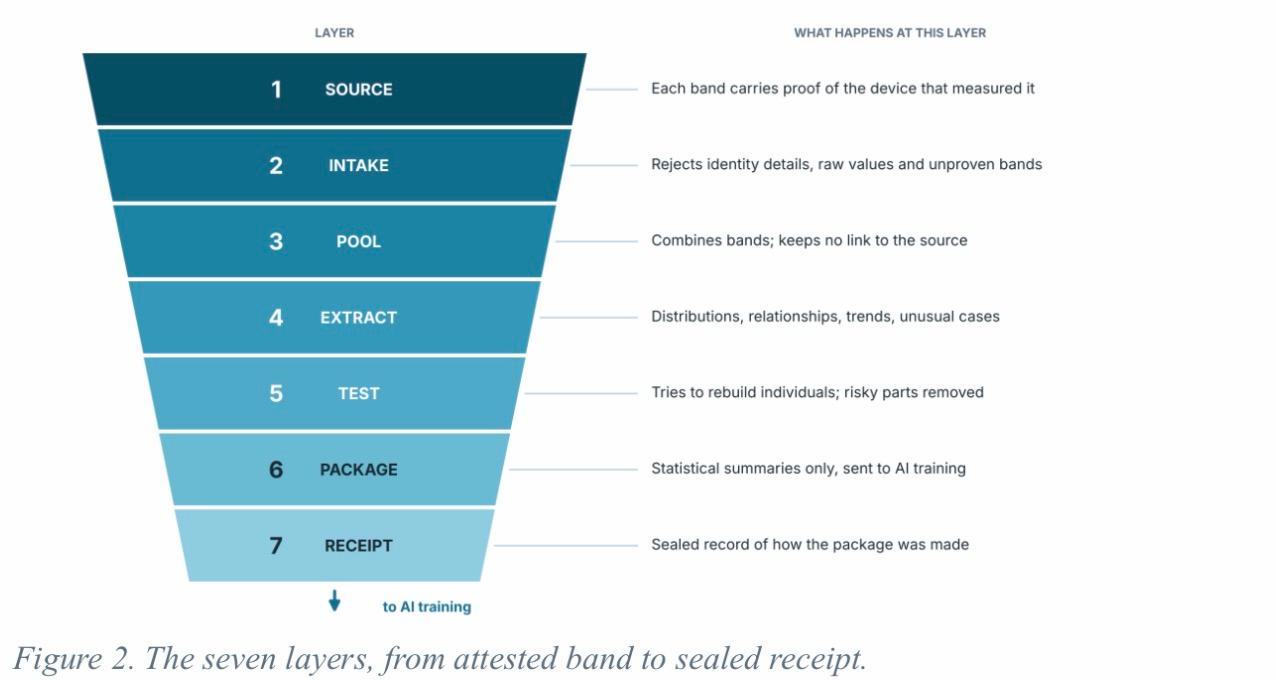
BDTS can be read as a chain of seven layers, from an attested band to a sealed receipt. Figure 2 shows them, and the next three sections explain each one.
Seven stacked layers narrowing from attested band to receipt: source, intake, pool, extract, test, package, receipt, ending at AI training
Figure 2. The seven layers, from attested band to sealed receipt.
LAYERS 1 TO 3: ADMIT, STRIP, POOL
Intake accepts no identity attribute, raw value, device identifier or other linking detail. It rejects any band without a hardware attestation certificate, which is proof that the band came from a measuring device. Pooling then balances the bands and aligns them in time. It keeps no link between a band and its source.
LAYERS 4 AND 5: EXTRACT, THEN TEST
The extraction step computes distributions, correlations, trends over time, groups and unusual cases, at settings declared by the sector authority. A privacy validator then simulates attacks: rebuilding individuals, detecting whether a person’s data was included, and working backwards from the output. Components that fail are suppressed or generalised before packaging, so the test comes before release, not after.
LAYERS 6 AND 7: PACKAGE AND PROVE
The package holds statistical summaries only: distributions, relationships between values, sequences over time and structures specific to a field. It holds no individual band, identity reference or raw figure. A sealed receipt records the group size bracket, validator result, package identifier, time window, method and jurisdiction, and that every contributing band was attested.
SUPPLY TO SUPERINTELLIGENCE AI
The filing names an AI model training interface as the receiving end. The route is designed to supply any model that accepts such input, including those aimed at superintelligence. What it supplies is structured statistics measured from people, with a receipt, rather than records or text.
WHAT CHANGES FOR AI DEVELOPERS
A developer receives a package and a receipt that names the group size bracket, time window and method. Developers can test each package against their own tasks and baselines.
WHY HUMAN-MADE, AND HOW A TRAINER CHECKS
Attestation ties each band to a measuring device, and the receipt records that none was unattested. A trainer can therefore see how a signal was made without seeing any source. The sealed record is designed to show which method was used, and whether it was changed.
WHO SETS THE LIMITS
Settings for each run come from the relevant sector authority, not from the pipeline. The receipt maps the package to its jurisdiction, so anyone checking can see which rules applied to the package.
PROVENANCE FROM THE FIRST STEP
The measuring device co-signs its attestation at the point of measurement, so provenance can start at the source. The receipt is sealed before transmission, with quantum-resilient signatures optional.
ONE ROUND, END TO END
Take several institutions that hold the same kind of human data. Each passes in bands only. The chain pools them and extracts a pattern. The validator finds one component that could expose a small group, so it is suppressed. The rest is packaged, sealed with a receipt and sent to training.
WHERE THE 0→1 DOCTRINE FITS
The 0→1 Doctrine places a need and an ability on one 0-to-1 scale, compares them for fit, and passes each case through decision gates and checks against stated rules. It can check a decision, such as whether to release or use a package. BDTS works without it, and the Doctrine works without BDTS. A holder may adopt either, or both.
WHO BENEFITS, AND WHAT TO COUNT
Institutions that hold human data gain a route into AI training without sending records out. AI developers gain traceable input. Authorities and auditors gain a receipt they can check. Early progress can be counted in pilots run, packages released and receipts issued, each a step toward a supply AI can draw on.
QUESTIONS INVESTORS ASK
What is the opportunity?
A route for institutions that hold human data to take part in AI training without handing over records, with a receipt for every package.
What does the AI side receive?
Structured statistics, such as distributions, correlations and patterns over time, delivered through the training interface.
How is trust built?
Every contributing band is attested, and a privacy validator tests each package before release.
What does a receipt record?
Group size bracket, validator result, package identifier, time window, method and jurisdiction. It describes how a package was made, not what training rights attach.
How is privacy handled?
Tests for rebuilding individuals, detecting inclusion and working backwards run before release. They are risk controls designed to reduce re-identification risk.
CLOSING NOTE
The wall stays. What crosses it is a tested pattern with a seal, and that is where a new supply of AI data may begin.
LIVE www.0to1doctrine.com
This can be tested, live, via API, governed against ungoverned, side by side.
THE INVENTOR
Systems theorist, inventor, and serial entrepreneur Vatsal Soin holds grants in the US, Japan, India and more; filings span six continents; latest grant, AI footwear, August 2026. Inventions: footwear, apparel fit, Sharable Size Cards, digital twins, robotics, global governed data, archive triage, quantum-resilient cryptography, AI governance. SIM–RMIT and NTU alumnus. Every prior invention was a step; 0→1 is the destination.
SELECTED REFERENCES
Granted: US Patent 12,446,652 B2 · Japan Patent 7560909 · India Patents 454081 and 599317. Filed: PCT/IN2025/051943 · US 19/489,595 · India 202511115781 · Australia AU2022450649 · India 202611113867 (23 September 2026) · PCT/IN2026/052042 (1 October 2026).
DISCLAIMER
Informational only. Not certified. No endorsement implied. Not investment advice. Examples are illustrative, not field results. Vatsal Soin · © 2026 All Rights Reserved.